Manuscript survives centuries of turmoil –
A crowning achievement for longtime UW-Madison music professor Lawrence Earp
February 3, 2015
By Michael Muckian
For the first time in history, a formerly inaccessible manuscript of the medieval composer Guillaume de Machaut will become widely available for study, thanks to a new hardbound facsimile version just released by the Digital Image Archive of Medieval Music (DIAMM) in Oxford, England.

A page from the Ferrell-Vogüé manuscript of medieval composer Guillaume de Machaut
The publication of The Ferrell-Vogüé Machaut Manuscript, one of six such illuminated manuscripts and long unavailable to scholars, renders complete the source material for the 14th Century French composer many consider to be the greatest musical and poetic influence of his day, according to Lawrence Earp, professor of musicology at the University of Wisconsin-Madison School of Music and the world’s foremost scholar of Machaut’s manuscripts.
The Machaut manuscripts, brilliantly illuminated with paintings and poetry, have long been sought after by art collectors as well as scholars for the insights they provided into the composer. The composer’s influence over the evolution of music as demonstrated in the manuscripts is undeniable, Earp said.
“Starting in the early 14th Century, there was a revolution in the rhythmic development in music that became known as Ars Nova, or ‘New Art,’” Earp says. Machaut’s music, composed with sophisticated syncopations, includes the first complete polyphonic setting of the Mass Ordinary, as well as love songs set to polyphony for the first time.
Listen to music of Guillaume de Machaut.
In Machaut’s manuscripts, for the first time in musical history, the canon of a single composer is clearly identified, says Earp, who wrote the introductory study to the new volume.
“These six manuscripts present a glorious anomaly, inasmuch as each consists solely of the works of a single author and documents the full extent of that author’s oeuvre at the time of the manuscript’s production,” Earp writes in his introduction. “They mark the culmination of a distinctly French tradition in which the single codex became the site of symbiotic interplay between poetry, illumination, and, in the most opulent examples, music.”
Earp, who has taught at the UW since 1984, wrote his Ph.D. thesis on Machaut and has studied the composer’s works and manuscripts extensively. The completion of the Machaut collection, of which The Ferrell-Vogüé Machaut Manuscript is the third of six extant illustrated manuscripts of Machaut’s works, allows for authoritative and comprehensive study of a composer whose works were highly influential to the evolution of both poetry and music, Earp says.
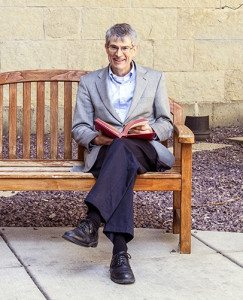
Lawrence Earp. Photograph by Michael R. Anderson.
“For musicians and scholars interested in serious study, access to these manuscripts is quite critical,” Earp says. “We now have the possibility to study the chronological stylistic development of the music from early to late periods. Because of the nature of Machaut’s complete-works manuscripts, that possibility exists for no other composer from the period.”
The Ferrell-Vogüé Machaut Manuscript, also known as the Codex Vogüé, has long been considered one of the most elusive of all of the great illuminated Medieval manuscripts. Dating from 1370-72, the Codex Vogüé came into the possession of Jean, duc de Berry, brother of king Charles V and the most famous royal bibliophile of the Middle Ages. It was passed to Gaston Fébus, count of Foix, who lent it in 1389 to Yolande de Bar, queen of Aragon, who never returned it.
Instead, the manuscript became part of the royal library of Aragon in Valencia, Spain, where it was recorded in 1417 in the possession of Alfonso the Magnanimous. Forgotten on a dusty shelf in Spain for nearly 300 years, the manuscript returned to France in the mid-18th century.
In the 19th century, the manuscript was owned by the Vogüé family in France, who sold it to French collector Georges Wildenstein in 1924.
As co-author Carla Shapreau of the Law School at the University of California at Berkeley relates, Wildenstein stored the manuscript in a Paris bank vault that was looted by the Nazis in 1940. After the war, the manuscript was recovered from a monastery near Munich by the Americans and returned to Wildenstein in 1949, now residing in New York city. At no time during Wildenstein’s possession was the manuscript made available to scholars for study.
The Ferrell-Vogüé Machaut Manuscript was purchased in 1999 by collectors James E. and Elizabeth J. Ferrell, owners of Ferrellgas, based in Overland Park, Kans., the second largest retailer of propane gas in the U.S. The Ferrells placed the manuscript on deposit in the Parker Library at Corpus Christi College, Cambridge, in 2004. The manuscript was digitized in 2009 and has now been released in hardbound copies.

“Machaut’s work was groundbreaking in many ways,” says Earp. “The publication by DIAMM of The Ferrell-Vogüé Machaut Manuscript is a true gift to scholars of medieval literature, music, and art.”
For more information about DIAMM’s publication of The Ferrell-Vogüé Machaut Manuscript, write to DIAMM@music.ox.ac.uk. You may also write to DIAMM at Faculty of Music, University of Oxford, Oxford OX1 1DB, United Kingdom.
To purchase the manuscript, see this link.